



Website brief template
Use this website brief template to explain your business, goals and pages to any web designer. Twelve sections, examples of good answers and common gaps.
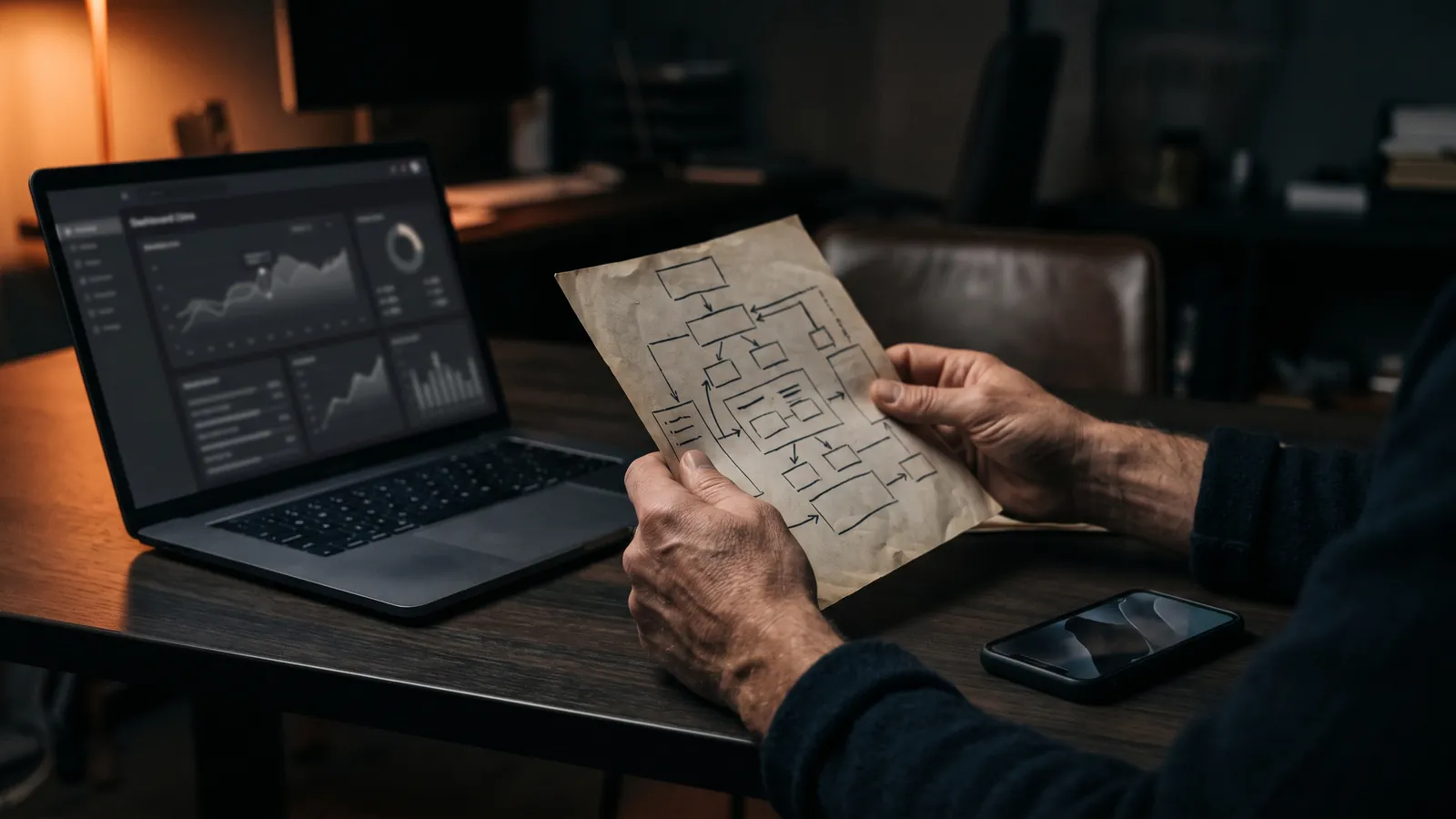
A website brief is a short document that tells a web designer what your business does, who the website is for, what it must achieve and what you already have. A good one fits on two or three pages and saves weeks of back-and-forth. Below is a template with twelve sections you can copy, fill in and send to anyone who quotes on your website.
You do not need to write like a marketer. Short, honest answers in your own words are exactly what a designer needs. If you do not know an answer, write "not sure", which is useful too.
Why the brief matters more than the design
Most websites that disappoint were not badly designed. They were built on guesses. The designer guessed which services matter most, guessed who the customers are, guessed what "modern" meant to you. A brief replaces those guesses with facts, and it also makes quotes comparable: when three designers price the same brief, you can see who is cheap because they left things out.
The website brief template
Copy these headings into a document and answer each one.
1. Your business in two sentences
What you do and for whom. Good: "I install and service split-system air conditioners for homes and small offices in Adelaide's southern and eastern suburbs." Weak: "Climate solutions for every need."
2. The main goal of the website
Pick one main action: phone calls, quote requests, bookings, online sales, job applications. Then list any secondary ones. A site that tries to do everything equally usually does nothing well.
3. Your ideal customers
Who they are, where they live, what problem brings them to you, what they worry about before buying. If you have a few types (homeowners and property managers, say), describe each one. There is help on this in how to define your target customer.
4. Services and priorities
List every service, then mark the two or three that bring the most profit or that you want more of. Those get the most prominent place on the site.
5. Where you work
Suburbs, regions, cities or "Australia-wide". If you travel to some areas only for bigger jobs, say so. For a mobile business this section shapes the whole site structure.
6. Prices
Your starting prices or typical ranges, and what changes them. Even if you do not want them published, the designer needs them to write honest copy.
7. Why people choose you
What do customers say when they recommend you? Fast response, tidy work, a particular speciality, speaking their language? Write real reasons, not "quality and professionalism". If this is hard, read USP examples for service businesses.
8. Competitors and websites you like
Name two or three competitors and say what you think of their sites. Then list two or three websites you like, from any industry, and what exactly you like about each (the layout, the photos, how easy the booking is).
9. Pages you think you need
A first guess is fine: home, one page per main service, about, contact, maybe pricing, gallery, areas served, FAQ. The designer should challenge and refine this list.
10. Features
Forms, online booking, a quote calculator, payments, a members area, a second language, integration with your CRM or job management software. Mark each as "must have" or "nice to have".
11. What you already have
Logo and brand colours, photos (and whether you own the rights), existing copy, a current website, the domain and who it is registered to, Google Business Profile, analytics and ad accounts.
12. Budget, deadline and decision maker
A budget range, a launch date and any reason behind it (a season, a new location, EOFY), and the one person who approves the work.
Common gaps that cause trouble later
When I read briefs, these are the gaps that most often lead to delays or a site that misses the mark:
| Gap | What happens |
|---|---|
| No priority among services | The homepage gives every service equal weight and sells none |
| Service area left vague | Pages cannot target the suburbs people actually search |
| "Modern and clean" as the only style note | Endless design rounds while everyone guesses |
| No mention of who owns the domain | Launch day stalls while someone hunts for logins |
| No budget given | Quotes for very different projects that cannot be compared |
| Several decision makers | Conflicting feedback and extra revision rounds |
An example of a filled-in section
Here is how section 5 might look for a mobile dog groomer: "Based in Joondalup. Regular visits across the northern suburbs from Clarkson to Scarborough. Ellenbrook and the Swan Valley on Thursdays only. No CBD or south of the river, except for existing clients." Four lines, and the designer now knows to build an areas page, mention the Thursday route and avoid promising coverage you cannot deliver.
How detailed should a brief be?
Two to three pages is plenty for a small business website. A large project with many page types, integrations or several locations may need more, but a long brief is not automatically a good one. Ten clear answers beat thirty pages of corporate wording. Bullet points are fine.
If writing is not your thing, record a voice memo answering each question and send that. I have worked from voice notes in English, Polish, Russian and Ukrainian; what matters is the information, not the format.
What happens after you send the brief
With me, the brief is the start of a conversation rather than a contract. I read it, ask follow-up questions, and we talk on a free 30-minute call. Then you get a written plan: the page list, features, price and timeline. Once you agree, the brief becomes part of the project and everything I write and design is checked against it.
You can fill in the website brief form on my site, which follows the same sections as this template, or send your own document by email or WhatsApp. If you want to see what a finished site built from a brief looks like, the Boreal Kitchens case study from Edmonton, Canada shows a website with a 3D calculator and CRM. For timelines once the brief is in, see how long it takes to build a website.
Let’s talk
about your business
Before the call I review your website and ads. After the call you get an action plan and a price range in writing.

12+ years in online marketing, 100+ clients. I build websites, Google Ads and Meta ads campaigns, CRMs and automations for small and mid-sized businesses. About me →
Website brief
questions
Do I need a brief if I am going to talk to the designer anyway?
Yes, even a short one. A call covers a lot, but details get forgotten and people remember conversations differently. A written brief gives both sides the same reference point and makes it easy to check later whether the site matches what you asked for.
What if I do not know which pages I need?
Write down your services and what customers ask you most, and leave the page list to the designer. Deciding the structure is part of their job. A good designer will turn your services, areas and goals into a sensible list of pages and explain why.
Should I include my budget in the brief?
It helps. Without a budget, one designer might quote a simple five-page site and another a large custom build, and you cannot compare them. A range is enough. A good designer will tell you honestly what is possible within it and what would need more.
Turn your answers into
a written quote
Fill in the brief, or send me the twelve answers in any format you like. I will reply within 1 business day with questions or a price.