Margin
Price set by someone else
The buyer sets the price and the spec. Good years and bad years feel much the same at the bank.
Ads and visibility: customers who are looking for your service now or don’t know about it yet.
01 Google AdsEnquiries from people searching for your service right nowfrom $800/mo 02 Social media adsMeta, TikTok, LinkedIn: customers who are not searching yetfrom $800/mo 03 SEOHigher in Google and Maps without paying per clickfrom $690/mo 04 Visibility in ChatGPT and AIYour business in AI assistant answerspart of SEO 05 Amazon, eBay and marketplacesSell where customers already buywith a partnerThe place where a visit turns into an enquiry, and a system that doesn’t lose that enquiry.
01 Web designA website that turns visits into enquirieslanding from $750 02 Online storesCart, payments and shipping, ready for adsfrom $2,300 03 CRMNo enquiry gets lost in a phonesetup $1,100 04 Chatbots and AIThey answer customers, at night too$550 05 Email and SMSCustomers come back instead of forgetting youquoted individuallyPlan and tracking first, budget second. You know what works before you spend more.
01 Strategy and auditKnow where to spend the budget before you spend it$700 02 AnalyticsSee which ad brings in money$470 03 ConsultationsA call about your specific problem$35/h 04 Free auditA quick review and 3–5 priorities to start$0How your business looks and sounds before anyone calls you.
01 Social media managementProfiles that look like a real businesswith a partner 02 Creative and videoGraphics and videos that stop the thumbquoted individually 03 BrandingA logo and style that sets you apartwith a partner Edmonton, Canada
website with a 3D calculator and a CRM
Boreal Kitchens
 Winnipeg, Canada
website and CRM in one system
Adela Strycharz, REALTOR®
 Żywiec, Poland
500+ page website and CRM for a chain
Gładko Tnący Barber
 Warsaw, Poland
website in 4 languages, calculators and CRM
MagCleaning
Marketing for farms and agribusiness that sells closer to the customer: farm gate and online orders.
Free: a 30-minute call, an action plan and a price range in writing.
Selling only through wholesalers and supermarkets leaves little margin. Selling direct needs marketing most farms have no time for.
The buyer sets the price and the spec. Good years and bad years feel much the same at the bank.
Harvest, livestock, weather. A Facebook page that was last updated two seasons ago.
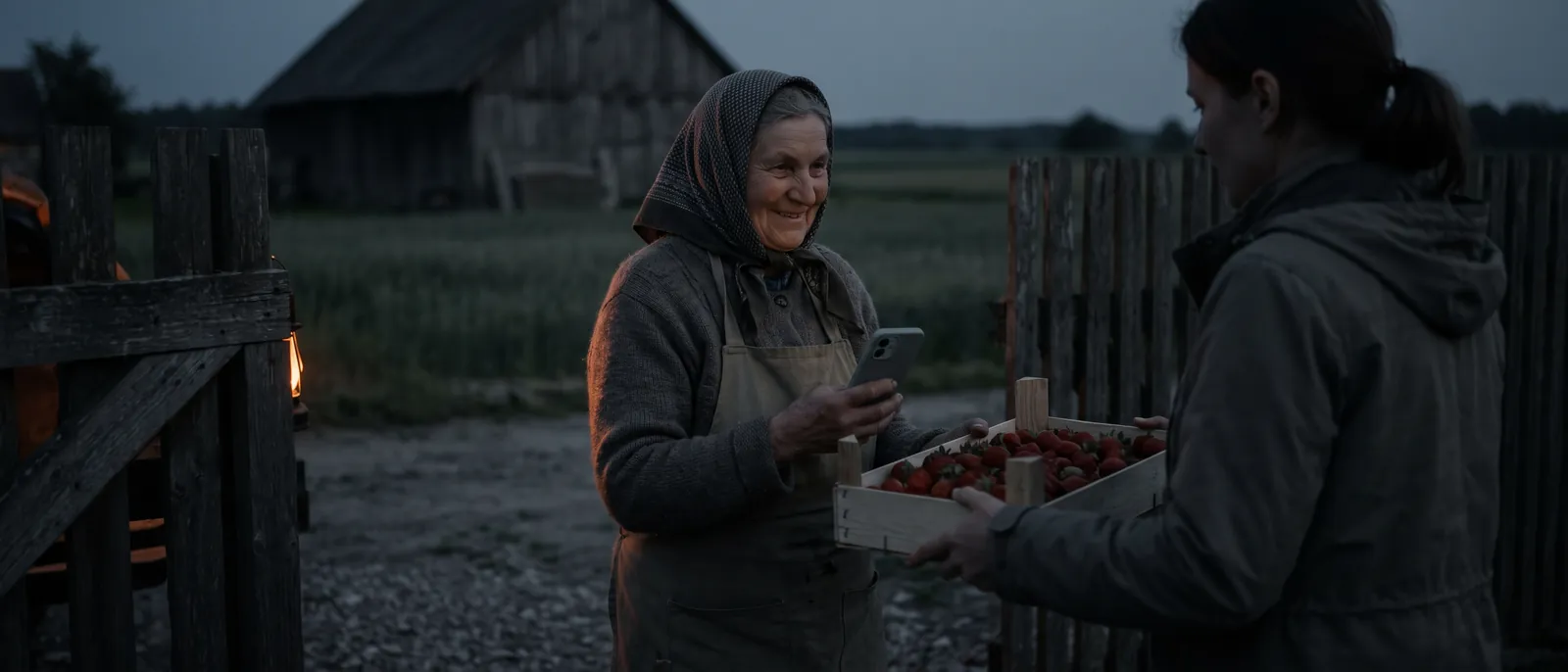
The strawberries are ready, the shed is open, and the people two hours away in the city have no idea.
Before calling, customers read reviews. I help you collect them and reply in a way that builds trust.
Produce boxes, meat packs, wine, olive oil. Pickup at the farm gate or delivery by postcode, paid online.
"Pick your own strawberries near me" and "farm gate honey" are map searches. Correct hours and seasons are essential.
Short videos from the paddock or the orchard, aimed at city people within a day trip.
A message to past visitors and buyers when cherries, mangoes or lambs are ready. Always with consent and an unsubscribe link.
A food business taking orders on its own website with a CRM and ads, instead of relying on third-party platforms.
See the case study →An online store built for timed drops on 11–12 December 2026, the same mechanics as a seasonal produce release.
See the case study →What you produce, when, how much you can sell direct and how you deliver.
Products, seasons, pickup and delivery zones, payment. You edit stock yourself.
Google profile, Apple Maps, a page per product and local tourism listings.
Emails and ads timed to harvest, holidays and events.
Final prices. Hosting and domain are agreed individually. Ad budget goes straight to Meta or Google.
Produce, packs or wine sold online with pickup or delivery by postcode.
For agritourism and farm stays: seasons, activities, booking links and directions.
After a $430 setup. Season campaigns aimed at day-trip distance.
Most Australian farms sell through wholesalers, processors, co-ops or supermarkets, and that will not change overnight. But a growing number add a direct channel: farm gate sales, online orders, produce boxes, agritourism, markets. Marketing for farms is about making that direct channel work without eating the time you need for the farm itself. The tools are simple; the timing and the honesty of the story matter more.
Farm marketing follows the season in a way no other business does. Strawberries, cherries, mangoes, stone fruit, apples, lamb, honey and wine each have their moment, and the moment differs between Tasmania and Far North Queensland. A season calendar on the website, an email the week the crop is ready, and short ads aimed at people within a day trip turn a harvest into a visitor weekend. Then everything goes quiet until next year, which suits farm budgets. Weather complicates it: a wet spring or a drought changes dates, so the website must be easy to update from a phone.
An online store for a farm is simpler than a regular shop but has its own rules: products switched on and off by season, pickup days at the farm gate, delivery only to certain postcodes, perhaps a weekly box with a cutoff day. Payment by card, with clear prices including delivery. Couriers such as Australia Post or a refrigerated carrier for perishables depend on what you sell. The customer list stays with you, which is the real long-term value: next season, you sell to people who already know you.
City buyers love knowing where their food comes from, and that story is a strong selling point. It is also regulated. Country of origin claims follow specific rules under the Australian Consumer Law, and words like organic, free range, grass fed or regenerative should be accurate and, where possible, backed by a recognised scheme. Food safety rules for meat, dairy and eggs differ by state. I write the story; you confirm each claim.
Farm stays, pick-your-own days, cellar doors and farm tours sell experiences rather than produce. They need a website with dates, prices, booking and directions, a well-kept Google Business Profile with seasonal hours, and listings with the regional tourism body. School holidays and long weekends are peak times; Meta ads aimed at nearby cities fill them.
Agribusiness suppliers have the opposite challenge: reaching busy farmers across big regions. Pages per region and product, campaigns timed to planting and harvest, and a phone number that gets answered matter more than polish. Regional hubs like Toowoomba, Dubbo and Wagga Wagga are typical bases for this kind of business.
For most farms, a simple website with a season calendar and a Google profile is the first step; an online store follows once you know what sells direct.
Often yes, but food safety rules apply and they differ by product and state. Meat, dairy and eggs usually need licensed processing and proper handling for delivery. Check with your state's food authority first. Once that is in place, an online store with pickup days and cool-chain delivery zones works well.
Country of origin labelling rules apply to food sold in Australia, and claims like "grown in Australia" or "product of Australia" have defined meanings under consumer law. Words like "organic" or "free range" also need to be true and, ideally, backed by certification. I write the copy; you confirm every claim.
Usually, if you time it right. A few weeks of Meta ads to families within a day trip, a correct Google profile with season dates, and an email to last year's visitors can fill weekends. Outside the season, ads stop and costs drop to zero.
Yes. The edit panel is light and works on a phone with a weak signal. You can switch products on and off, change pickup times or post a season update in a minute from the ute.
Yes. Businesses selling machinery, inputs or services to farmers need a different approach: clear product and service pages, regional pages and campaigns timed to planting and harvest. Farmers search on their phones, often late at night after work.
Tell me what you produce, where you are and how you sell now. I reply within one business day, or book the free 30-minute call.
What do you need most?