



Ad graphics design
Ad graphics design for businesses that need static ads and carousels which say one thing clearly, fit every placement, and come in enough versions to find out what actually works.
Free: a 30-minute call, an action plan and a price range in writing.
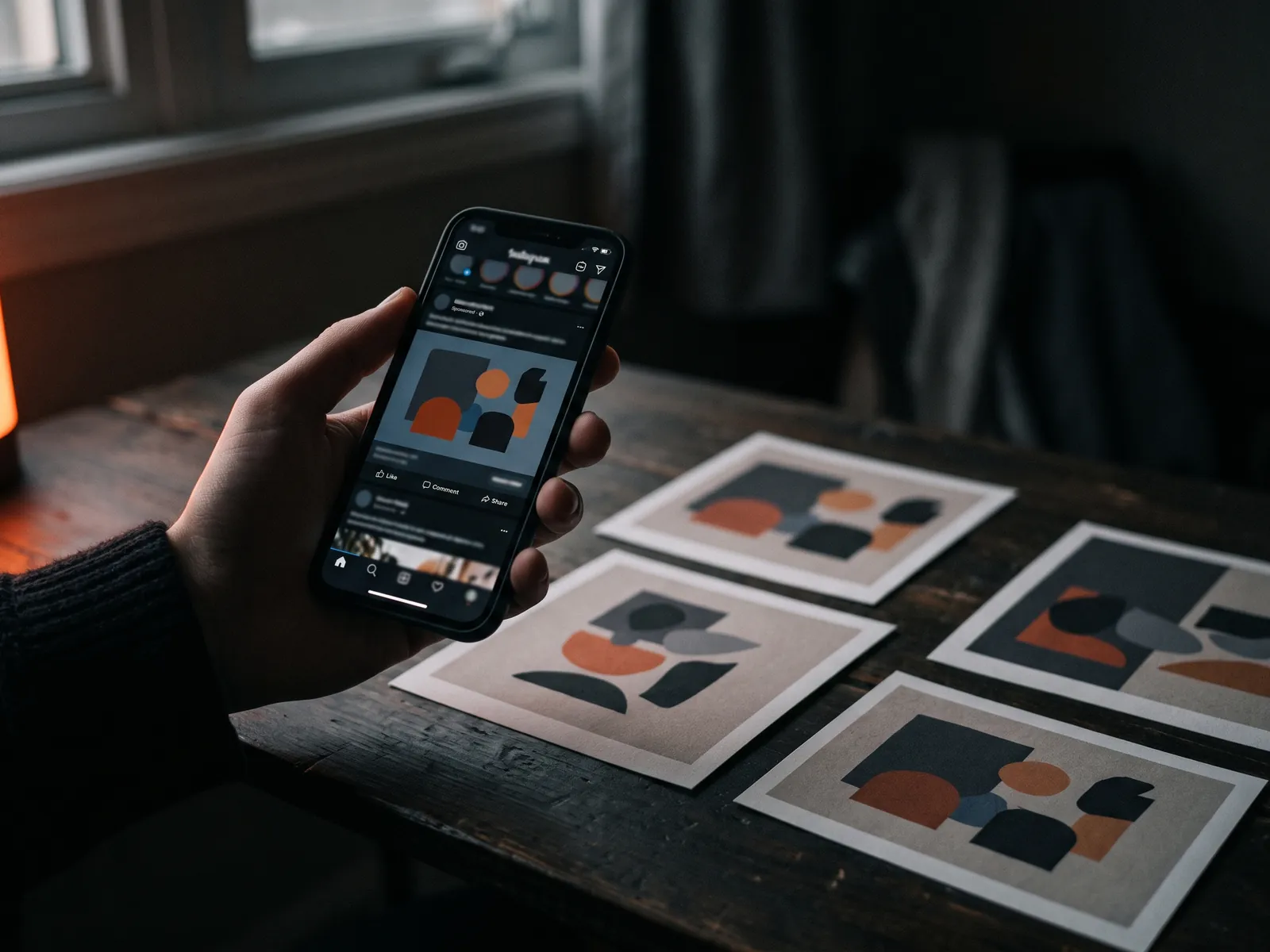
What a set of
ad graphics includes
Two to four different messages, each a separate reason to choose you, rather than one ad with everything crammed in.
Square and 4:5 for feeds, 9:16 for Stories and Reels, landscape for Google display and Performance Max.
Step-by-step cards for services, product ranges or before-and-after sets, each card readable on its own.
Primary text, headlines and descriptions written to match each graphic, in Australian English.
Final images plus editable sources, so prices and dates can be changed later without starting again.
From brief to
upload-ready files
Brief
Offer, audience, prices, photos you have and where the ads will run.
Concepts
Rough layouts for each angle, so you approve the idea before the polish.
Design
Final graphics in every size, with matching copy.
Revisions
Up to three rounds of changes, included in the price.
Handover or launch
Files delivered in a shared folder, or uploaded straight into campaigns I manage.
Ad graphics
pricing
In Australian dollars, quoted individually by the number of angles, sizes and versions.
Free 30-minute call on your current ads.
- What is unclear at a glance
- Angles to try
- Scope for a quote
Static ads and carousels for your campaigns.
- Several angles
- All placements
- Copy included
- 3 rounds of revisions
What makes ad graphics work
Ad graphics design starts with one message
Good ad graphics design is mostly about deciding what to leave out. A person scrolling through Instagram on the train gives an ad less than a second. In that time they need to see what it is, who it is for and why it is worth a tap. That leaves room for one message, one image and one short line of text, not your whole service list.
So before any design, I pick the angle. Is this ad about price, speed, quality you can see, or a problem the customer knows too well? Each angle gets its own set of graphics, and we let the results show which one your customers care about.
Sizes and safe zones
Different placements crop and cover graphics in different ways:
| Placement | Shape | Watch out for |
|---|---|---|
| Facebook and Instagram feed | 1:1 or 4:5 | Long text truncated under the image |
| Stories and Reels | 9:16 | Profile name at the top, buttons at the bottom |
| Google display and Performance Max | 1.91:1, 1:1, 4:5 and others | Small sizes where text becomes unreadable |
| Carousels | 1:1 per card | Each card has to make sense alone |
Designing each shape separately takes longer than cropping, but it means the offer is never hidden behind a button.
What usually works for local businesses
For trades, health practices, salons and other local services, the strongest ad graphics are usually simple: a real photo of a finished job or the team, a short headline with the outcome, and a clear sign of where you work. A suburb name or "servicing the Gold Coast" in the image tells people instantly that you are local to them. Stock photos of smiling models tend to do the opposite.
For online stores, product shots on clean backgrounds work for catalogue ads, while lifestyle images and carousels do better for new audiences. Seasonal sets for Christmas, Boxing Day or EOFY need to be ready a few weeks before the date, which is part of the plan.
Claims, prices and the law
Under the Australian Consumer Law, ad graphics must not mislead. In practice that means prices show the full amount a customer will pay, "from" prices are genuinely available, "was" prices were real, and comparisons with competitors are fair and provable. Words like "guaranteed", "best" or "cheapest" need care. Health practitioners have extra limits under AHPRA, including on before-and-after images, and therapeutic products fall under TGA rules. I would rather adjust a headline now than have an ad rejected or a complaint later.
Text in the ad versus text on the image
The image carries the hook. The primary text carries the detail: what is included, how to book, service areas. The headline under the image reinforces the action. I write all three together, so they do not repeat each other word for word. All copy is in Australian English with local terms, such as "quote" and "enquiry", that your customers would use.
Testing without wasting budget
More versions are not always better. With a modest budget, splitting money across a dozen graphics means none of them gets enough impressions to prove anything. I usually start with two or three angles and two designs each, let them run long enough to see a difference in cost per enquiry or sale, then replace the weakest with a new variation of the strongest. Over a few rounds the ads get sharper and the cost of each result tends to settle at a level you can plan around.
Who makes your graphics
I design ad graphics myself, not through a partner. If I also run your Facebook ads or Google display campaigns, new versions go straight into tests and the results come back to me every two weeks. If you run the ads yourself, you get the files and a short note on what to test first. For the wider approach to creative, see the ad creative overview, or book a free consultation to talk it through.
Where the graphics run
Ad graphics FAQ
Can I put a lot of text on an ad graphic?
You can, but it rarely helps. A graphic should carry one message, readable on a phone in a second: an offer, a price, a result. The details belong in the ad text and on the landing page. Meta no longer blocks text-heavy images, but busy graphics still tend to get less attention.
Do you use stock photos?
Only when there is no better option, and never pretending to be your staff or your work. Real photos of your jobs, products and team almost always do better for a local business. If you have none, I send a short shot list so you can take them on a phone.
Can I show prices in the ads?
Usually yes, and it often helps. The price must be accurate and show the total a customer will pay, including unavoidable fees, under the Australian Consumer Law. Starting prices need to be genuinely available, and was/now comparisons must reflect real previous prices.
How often should graphics be refreshed?
It depends on budget and audience size. With a small local audience, people see the same ad often, so new versions every few weeks help. With a broad national audience, a strong ad can last longer. If I run the campaigns, the results show when it is time.
What formats do you deliver?
PNG or JPG for the ads in each required size, plus editable source files. If your team works in Canva, layouts can be supplied as templates there so simple changes like dates and prices do not need me.
Get a set of ads
worth testing
Send a link to your website and tell me where you advertise. I will reply within one business day with angle ideas and a quote.