



Business card
and print design
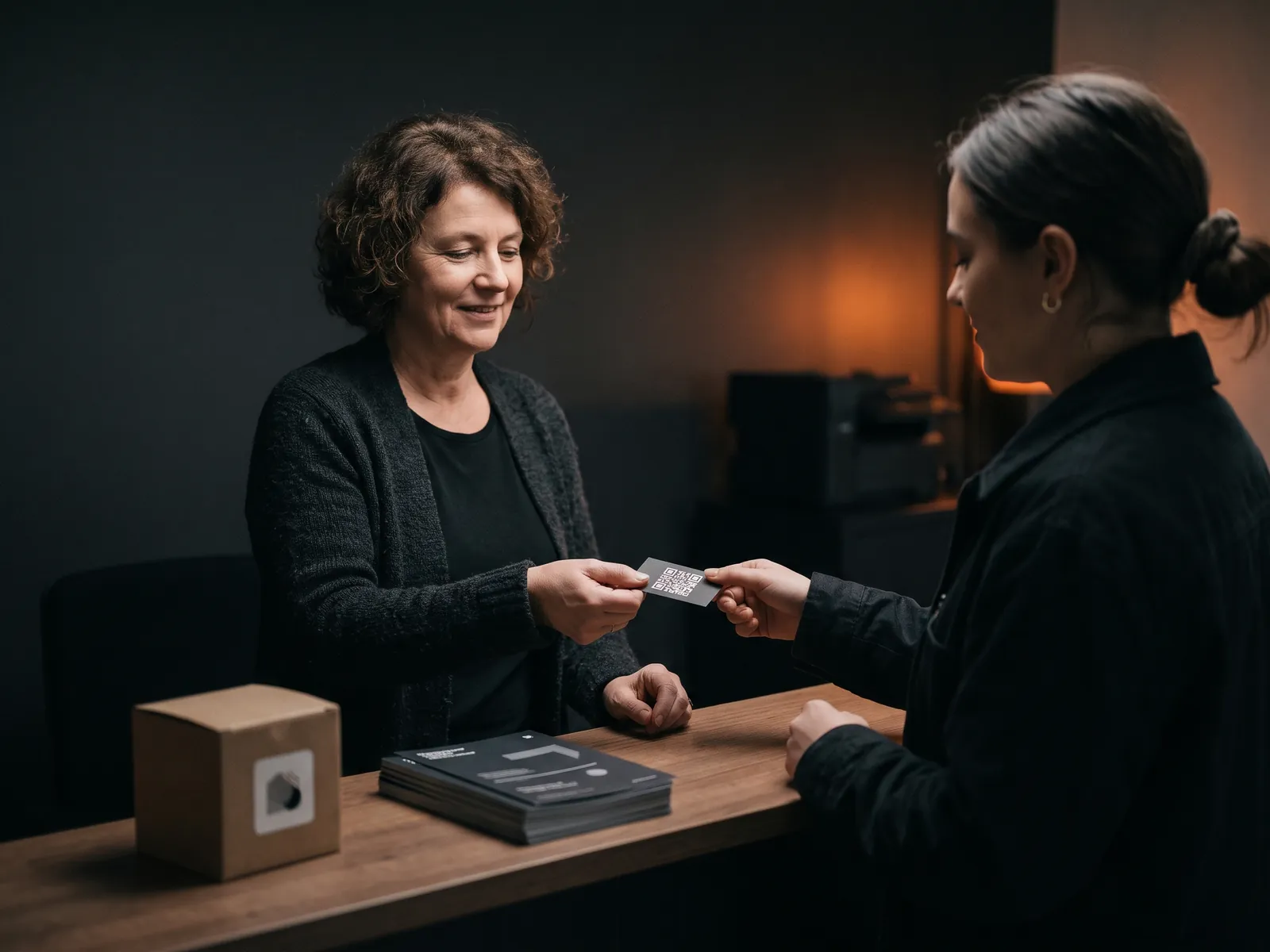
Business card and print design for businesses that still meet customers in person: at the counter, on site, at the markets or in the letterbox. Every piece points somewhere useful online, and the files are ready for any Australian printer.
Free: a 30-minute call, an action plan and a price range in writing.
Print pieces that
lead to an enquiry
Clear name, role, phone and a QR code to your booking page, website or WhatsApp.
DL, A5 and A4 flyers with one offer and one action, written for people who glance for three seconds.
Shopfront signs, A-frames, pull-up banners for expos and markets, readable from a distance.
Designs for utes, vans and trailers: name, service and phone readable at a glance in traffic.
Letterhead, quote and invoice layouts, stickers, labels and packaging inserts.
One brand
from logo to ads
Logo, colours and typeface come together into a system that works on your website, in ads and on your sign.
- Logo in several versions
- Palette and typography
- Social media templates
From brief to
print-ready files
Print design is delivered with my trusted branding partner. I write the brief and the copy, check every file and handle all communication. Printing is done by a printer of your choice.
Brief
What the piece is for, where it will be seen, quantity and the printer or sign writer you use.
Copy and layout
Short, clear text and a draft layout for your approval.
Design
Final design in your brand, with up to three rounds of revisions.
Print-ready files
PDFs set up to your printer's specs: CMYK, bleed, crop marks, fonts embedded.

Print design pricing
Quoted individually in Australian dollars, by the number and type of pieces. Printing is paid directly to your printer.
Thirty minutes on what you need printed.
- Which pieces are worth it
- Sizes and formats
- Scope for a quote
Copy, design and print-ready files.
- Copy written for you
- Tracked QR codes
- 3 rounds of revisions
- Files for any printer
Print that still
works in 2026
Business card and print design in a digital world
Plenty of Australian businesses still win customers in person: a tradie handing a card to a neighbour over the fence, a cafe putting a menu in the letterbox, a stallholder at the weekend markets, an exhibitor at a trade expo. Print has not disappeared; its job has changed. Business card and print design now works best as a bridge: something in the hand that sends people to your website, booking page or messaging app.
That is why every piece I design has one clear next step and, usually, a QR code that is tracked. You can then see how many people scanned the flyer from your letterbox drop in Ringwood versus the one at the Bendigo show.
Business cards that do a job
A business card should make it easy to contact you and easy to remember who you are. Name, role, phone, email and website, in a readable size, plus your logo and one line about what you do. Many owners add a QR code that opens a contact card or a booking page, which saves the customer typing.
The standard Australian card size is 90 by 55 mm. Heavier card stock and a clean layout often matter more than special finishes. Foil and spot gloss can look great but add cost and lead time, so they make sense mainly for premium brands.
Flyers and letterbox drops
Flyers work when they are simple. People decide in a few seconds whether to keep or bin a flyer, so the design should carry:
- one headline that names the benefit or offer
- a short list of services or a menu, not a wall of text
- the suburbs you service, if relevant
- a clear call to action with phone, QR code or website
- a deadline only if it is real
DL is the most common size for letterbox drops; A5 and A4 suit counters and noticeboards. If you do a drop, respect "No junk mail" signs, which many households use, and track the response with a dedicated QR link or landing page. The UTM tracking guide explains how to tag those links.
Signs, banners and vehicles
For signs and vehicles, distance is everything. A ute is seen for a few seconds in traffic; a shop sign is read from across the road. The design should show your name, what you do and how to contact you, in large type with strong contrast. Fine detail, long service lists and small fonts are wasted. Australian sun also fades colours over time, so durable materials and simple colour schemes are worth discussing with your sign writer.
Pull-up banners for expos and markets follow similar rules: key message at eye level, logo high up, nothing important at the bottom where it will be hidden by a table.
Print-ready files done properly
Files for print need technical care: CMYK colour, bleed (usually 3 mm), crop marks, embedded fonts and the right resolution. Mistakes lead to white edges, blurry images or colours that do not match your screen. I check every file against your printer's specs before handing it over. You can use any printer in Australia, online or down the road, and reorder from the same files whenever you need.
Claims in print
Printed material is advertising too. Under the Australian Consumer Law, prices on flyers should show the full amount customers pay, offers must be genuine, and comparisons fair. Licence numbers are required on advertising for some trades in some states, so if you are a builder, electrician or plumber, check your state's rules and include your licence number where needed.
Working with me
Print design is delivered with my trusted branding partner. I write the copy, set up tracking for QR codes, check every file and handle all communication. Your logo files from logo design are used directly, so everything matches. I work remotely with businesses across Australia and have no Australian clients yet. To talk about what is worth printing, book a free consultation.
Print works best with
Print design FAQ
Do you print the cards and flyers too?
No, I supply print-ready files and you choose the printer, online or local. That keeps printing costs transparent and lets you reorder anywhere. If your printer has particular specs, send them and the files are set up to match.
What size is a standard Australian business card?
The common Australian size is 90 by 55 mm, slightly different from the US size. Flyers are often DL (99 by 210 mm, the size of a standard envelope), A5 or A4. Files are always set up with bleed, usually 3 mm, unless your printer asks for something else.
Do letterbox drops still work?
For some local businesses, yes: tradies, takeaway food, real estate, gardening and cleaning services often use them. Results depend on the area, the offer and the design. Respect 'No junk mail' stickers, include a clear reason to act, and use a tracked QR code or dedicated phone number so you can tell whether the drop paid off.
Should I put a QR code on my business card?
Usually yes, if it goes somewhere useful: your booking page, a contact card, a WhatsApp chat or a landing page. A tracked link lets you see how many people scanned it. Always test the code on several phones before printing.
Can you design my ute or van graphics?
Yes. The design is supplied to your sign writer, who measures the vehicle and produces the wrap or decals. Vehicle graphics need very simple layouts: name, what you do, phone or website, readable in a few seconds from a distance.
Need cards, flyers
or van graphics?
Tell me what you need printed and which printer or sign writer you use. I will reply within one business day.